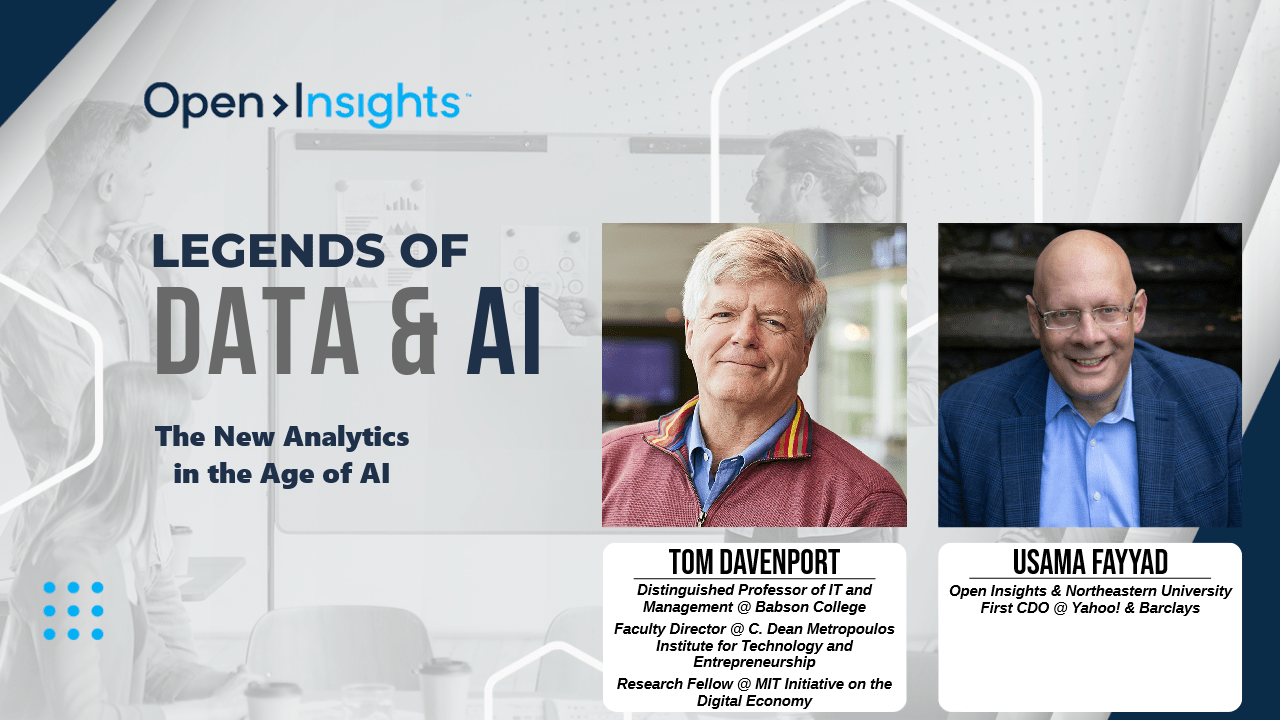
Usama Fayyad speaks with Tom Davenport – Distinguished Professor of IT and Management at Babson College, Faculty Director at C. Dean Metropoulos Institute for Technology and Entrepreneurship, Research Fellow at MIT Initiative on the Digital Economy. Tune in to hear Tom discuss the role of analytics in AI, his concern for the future of entry-level workers, as well as his views on the importance of well curated data.
Speaker’s Name: Tom Davenport
Speaker Bio: Tom Davenport is the President’s Distinguished Professor of Information Technology and Management at Babson College, co-founder of the International Institute for Analytics, Fellow at the MIT Initiative on the Digital Economy, and Senior Advisor to Deloitte Analytics. He teaches analytics/big data in executive programs at Babson, Harvard Business School and School of Public Health, and MIT Sloan School.
Davenport pioneered the concept of “competing on analytics” with his best-selling 2006 Harvard Business Review article and 2007 book. His most recent book is The AI Advantage: How to Put the Artificial Intelligence Revolution to Work. He wrote or edited nineteen other books and over 200 articles for Harvard Business Review, Sloan Management Review, The Financial Times, and many other publications. He is a regular contributor to the Wall Street Journal and Forbes.
Watch on : YouTube!
Listen on : Spotify
Transcript
Welcome to Legends of Data and AI. Each episode includes inspiring and actionable data and artificial intelligence insights from global leaders across industries.
Your host, Dr. Usama Fayyad, was the first chief data officer at Yahoo and is chairman of Open Insights and executive director of the Institute for Experiential AI at Northeastern University.

-Usama Fayyad:
Welcome everyone to another episode of our podcast Legends of Data and AI.
My name is Usama Fayyad.
I am chairman at open insights and senior vice provost of AI and data strategy at northeastern university where I also serve as senior adviser to the president and I'm the inaugural director of the institute for experiential AI at northeastern university.
I am so pleased to have with me today Tom Davenport, a huge name in analytics and thinking about analytics for business and how does AI and you know all the data assets and so forth fit in with organizations.
He is a distinguished professor at Babson College.
And I'll actually first of all welcome Tom and I'll ask you to say a few words about you know what else have you been doing recently that should be of interest to our audience.

-Tom Davenport:
Thanks.
Very happy to be here.
We've talked about doing this for a while but I'm glad we're finally doing it.
Apologies for my slight cold.
I am doing a few things.
Starting to live more of the portfolio life I guess.
I am a fellow of the MIT initiative on the digital economy which I've done for a while and I just started being a faculty fellow of the Stanford Institute for Human Centered AI.
So I I needed an affiliation on the West Coast.
So there you have it.
And I do various other things like you work with companies and and so on.

-Usama Fayyad:
Wonderful.
And of course I'm sure many of our audience have read your articles in the Harvard Business Review and the Sloan publication as well as of course your your books on these topics that have been super influential.

-Tom Davenport:
All created with generative AI.
I had nothing to do with it.

-Usama Fayyad:
Not yet although the next one I expect AI will be a co-author.
So your your work on competing on analytics which which of course started as a Harvard Business Review article when it was published and then became a the topic of a book.
It got a lot of attention as what it was very influential for businesses.
As we transition to most analytics being done by kind of the new deep learning and generative AIS along with the natural language communications abilities of these models.
You know, how do analytics evolve and how do you gain advantage with analytics as a business when everyone can get access to the same capabilities?

-Tom Davenport:
Well, I do think the whole area of analytics is changing and I was talking earlier today with a CEO who's asking, you know, how do I organize AI?
And I said, it's really crazy to separate analytics from AI because, you know, people not only are some types of analytics predictive analytics are basically simple forms of machine learning, but also people are using AI to do analytics.
So it really is a very changeable boundary and you don't want to separate them.
I mean I do still think that there is something to be said for understanding statistics and probability and data science and so on.
Even though, you know, we've had things like automated machine learning for a while and now we have the ability, as you say, to do, you know, English language prompts to create fairly complex machine learning models.
But I still think it's quite helpful to know what you're doing in that regard.
And I you know I not sure the appetite is even that high for a lot of people to do sophisticated analytics even if they can you know speak them into existence.
So wanting to make decisions on the basis of data and and analytics and AI and wanting prediction rather than looking backward and so on.
I mean that that's not something that AI inculcates in you.
You have to kind of be aware of the possibilities.
So I still think there is definitely a role to play for analytically and AI minded humans in this regard but it's changing and you know maybe diminishing a little bit.

-Usama Fayyad:
So that that brings us to kind of the craft of doing analytics and figuring out what to look for strategically, what questions to answer, what questions to ask even.
How does that change with with the AI capabilities?

-Tom Davenport:
Well, I mean theoretically you can you know tell Chat GPT or Claude or whatever give me a machine learning model and all you really have to know is what's the dependent variable or feature and and where the data set is.
And it'll sort of figure out, you know, which which independent variables predict that one.
And it'll run several different types of algorithms.
You might you might have to ask it for several.
It's kind of lazy.
It doesn't do them unless you say, you know, I want to try out different ones.
And it will tell you what to do with missing data.
And it will tell you which variables or features are most prominent in the in the resulting you know best model and then something that we've never had from statistical software in the past it'll tell you what to do about it I mean I demonstrate a lot with my students on a an attrition database in the mobile phone industry and it will tell you okay well you should bundle these products together going forward and you should really stop these promotions because you're just getting temporary customers and and so on.
So that we always had to rely on human understanding for and it's pretty good about explaining what's going on in the in the results.

-Usama Fayyad:
Yeah.
And and hopefully that allows you to do a a lot more faster and iterate faster.
Every AI project we do with or or for companies, whether it's at open insights as a private company or at the university as an as an institute, it immediately turns into a data project first.
This is because of course the total dependence of AI and and deep learning on on data as you well know.

-Tom Davenport:
I'm shocked that these companies data isn't all ready to go you know by the time you arrive.

-Usama Fayyad:
Yeah, I know that's the eternal state.
Are there new data issues companies need to worry about in the age of AI?
Because for the longest time they collected data for human analytic consumption and now they have to start thinking about algorithm consumption.
What are your thoughts?

-Tom Davenport:
Yeah. Well, you know, as you know, we've had AI on structured data for several decades now.
And you know, that data had to be high quality and more or less reflective of the world and the world changed and you didn't gather new data, it was probably not going to give you a terribly good model.
So there were some data criteria and necessities then but I think what's changed with generative AI in particular is we have a whole world of unstructured data that is really quite important and subject to you know manipulation and meaning making by generative AI systems and that's fine with me.
I was a before I was an analytics guy, I was a knowledge management guy.
And I worked in that area for several years and people got less interested in it.
And so that's when I I started saying well let's look at structured data and how people are extracting knowledge from data and that led to the analytics work.
But now of course we can do a lot with organizational knowledge and we can summarize it and package it up and make it accessible to people much more readily and and get a sense of what's happening with it much better than we ever could with you know Lotus Notes or SharePoint or the previous options.
And so that I think has opened up a whole new world.
It does, you know, it there's some new techniques.
You have to know something about vector databases with rag and so on.
And then you have to know something about knowledge graphs if you want to make sure that you're getting the right piece of knowledge.
But that's a big change and most organizations were not really focused on unstructured data for a long time.
They were focused on you know rows and columns of numbers basically and making sure that they were accurate and available and so that's a that's a big deal and you know it's opened up to images and video and so on.
So it's a it's a whole new world for a lot of companies.

-Usama Fayyad:
Yeah, I mean definitely I mean the likes of Gardner and others even acknowledge that the majority of data in any organization is unstructured and for the longest time we've we've for good reasons we've only been looking and paying attention to structured data.
So that's one major change.
The other change is data for algorithms need to be at a whole other level of granularity because you know they have to get all the effectively domain knowledge and understanding and all of that from the details which is not what you collect normally when you intend to be doing kind of higher level analytics and prediction by humans.
Any changes there any kind of impact on the thinking and the skills of how organizations should approach accumulating their data assets?

-Tom Davenport:
Yeah, I mean there's that old question of you know what do you hold on to versus what do you throw away?
And I think Jeff Bezos is famous for saying we never throw away data at Amazon.
And I'm not sure how much that philosophy has been responsible for their commercial success, but seems to have worked out pretty well for them so far.
And I do think that, you know, it used to be that we had to be much more conscious about what we thought the relationships were in our data and what variables might predict other variables.
And now you can just throw a huge data set in and say find tell me what's going on here.
And and it it also used to be that you know somebody was talking to me the other day about exploratory data analysis.
Do you remember that John Tuki at Bell Labs?

-Usama Fayyad:
Yeah. EDA of course.

-Tom Davenport:
Yeah. But I you know I think AI can do all that stuff for you.
You don't have to draw bucks and whisker plots on your own anymore.
And so I think you can dramatically accelerate your productivity.
However, you know, there's still maybe data that you're not collecting at all and AI has probably helped a bit with data collection.
It certainly helped with data integration.
I think that there's still, you know, a pretty substantial barrier to companies getting data that they've never collected before.
And, you know, most companies in the past were collecting data on their own financial performance and, there's again there's a whole new world of possibilities that's opened up that you can collect data on.
You know, maybe the weather is driving something about your performance or maybe I don't know, we could predict the impact of war in Iran if we just looked back at all the past wars of that type.
I don't know exactly what's been of that type exactly, but hopefully we'll be out of war in Iran before too many people watch this podcast.
But I think you know we can make sense of history in a way that we we haven't in the past.
But you've got to you know at least imagine those possibilities if you're going to be successful.

-Usama Fayyad:
Yeah. I think this this notion of of context and you know you mentioned the weather generally speaking news you know other events things like that that people may not think are relevant but they are could be very relevant in other hidden ways.
And our ability to consume more makes that very interesting.

-Tom Davenport:
Let me I love this term.
I don't know about you, but I don't get a whole lot from the intelligence and defense industry, but I love that term that they sometimes use, situational awareness.
Yeah, which is can be really quite quite broad.

-Usama Fayyad:
Indeed, that's a good term.
So as you put on your hat as a professor and educator, what is it that we should be teaching our students in this new age of AI where algorithms can perform at the competency level of undergrads and grads and now some claim PhD level students?
You know what what do we teach our students?

-Tom Davenport:
That's too hard a question.
I'm just going to retire before it happens.
No.
I think we have to, and I, you know, I I'm trying to do this in my classes now, and it's not easy at all.
We have to, encourage people to add value to these capabilities.
And then, you know, it's going to get harder and harder.
But I was just actually looking at there's some things that I hate about about publishing and writing and I'm co I'm doing a thing with a co-author and he's published a a more scientific paper and I hate doing that kind of translation into things for practitioners.
So, I asked Claude to do it for me this morning, and you know, it's pretty damn good, but it has the usual too many M dashes, too many bullet points, etc.
So, you have to go through and figure out how do I make this clearer?
How do I say something that is more of more value than what it does?
But you know to get students to do that frankly is like pulling teeth sometimes.
One of them said to me last time I was teaching this course it was a lot easier when I could just paraphrase a Wikipedia article and you're making me show what prompts I used and check the the citations and take sections and rewrite them and so on.
And that's not an easy thing to do.
But it's I think the only way we humans will survive in a in a world where we have these very strong capabilities or you know knowing that the I noticed several times for example that I this course that I teach is mostly about sort of the students want to know how to prompt better and so which is the best LLM but I try persuade them that's commodity knowledge.
And I try to talk about the impact of AI on different industries and and functions and so on.
And so when they do health care they invariably even you know in 20 last taught this almost a year ago but invariably it says well the leader in healthcare AI is IBM Watson.
And I said, "Oh yeah, have you looked at all at IBM Watson Health?" IBM doesn't own them anymore for one thing.
They sold it to a private equity firm and it's was largely discredited for being more marketing than than technology capability.
And so you know it's not your approach is useless unless you validate it because the world has changed since that that particular model was trained.
So but it's you know it's like being an editor as opposed to a writer of first drafts and not many journalists I suspect have trouble learning to be an editor and we we all have to do that now.

-Usama Fayyad:
Yeah.
And then there's there's also the reaction like if if humans kind of feel that you used AI to generate what you wrote the the appetite for reading drops dramatically.
I used to you know in a few two three years ago it used to be that the use of the word delve was the big giveaway.
If some if the engine uses delve I know it's AI.
Now actually I noticed that reimagine is my new keyword.
You see reimagine in the article it's like a 90% chance it's it's coming from from from a computer.

-Tom Davenport:
So do you stop reading where you see reimagine now?

-Usama Fayyad:
I don't you know the minute the minute I detect this is generated by AI I really lose kind of I don't want to put any energy reading or listening.
It's just like and that is something we need to think about and in terms of teaching students like getting them aware of the fact that the technology is not right and you mentioned it check the references and so forth do the work.
You know, I call I call it in in reference to autonomous driving, I call it sleeping at the wheel.
And if you're sleeping at the wheel, yeah, most of the time you're going to be okay.
But hey, when you're not okay, it's going to be really bad for you and your career.

-Tom Davenport:
Yeah.
And I was reading yesterday some cognitive scientist was hypothesizing that dementia will show a slow but a real increase over time because navigating your way through the world apparently is really good for your brain.
And if all you're doing is following a GPS you're you're not going to succeed in that regard.
And we already know that great MIT paper about your brain on on chat GPT.
We know that your brain cells don't get engaged unless you really force yourself to engage.
Now I don't know if you if you look at that anthropic economic report, there was some pretty good news I thought there which is that people who do engage with the content use AI much more frequently than those who don't.
Like 22 times as much.
So that was good news.
I think maybe humans are realizing that part of being human is not just, you know, generating an output and passing it along.

-Usama Fayyad:
Yep.
Yep.
So, along that line of of kind of specialization and sharpening the skills like what happens to the art of probabilistic modeling, prediction, statistical analytics in general, you know, as as the AI gets better, you know, what happens to our ability as as analysis people to kind of really influence?

-Tom Davenport:
Yeah, you know, I think it's already changed in part because of AI, but also you're partly responsible here because of big data, I would say.
Because of big data, nobody's really that interested in statistical significance anymore because everything was significant with all of that data that Yahoo or whatever was generating or Barclays.
So you know I hope that one thing that happens is that these systems the the ones that do analytics for you try to draw you in and don't just give you the answer but what do you think this means and does it make sense that this feature would would be as influential in the model as you think and is it reasonable to put in the mean for missing data and here's some of the implications of that.
So you'd really engage in a dialogue with it and it would tell you sort of what it thinks and in some cases you'd say that sounds good in some cases you'd say n that doesn't really really make sense.
That's how I'm starting to use these tools myself for analytical work.

-Usama Fayyad:
Yep. Yep. So I'm I'm curious and I'm sure a lot of our audience is curious.
Have you has has Tom Davenport been vibe coding for the purpose of analytics?
And and if so any impressions, observations or advice you might want to share?

-Tom Davenport:
Yeah, I'm really resentful of that term vibe coding because I don't know a few months before it came out I published a book called All Hands-On Tech and we ended up calling it citizen development which is not nearly as felicitous a term as vibe coding that you know it's a gardener term and so you know the book would have been a lot more popular if we stuck the vibe coding name on it.
But in any case, yeah, I as I say in teaching people, I was doing automated machine learning approaches for the past decade or so and then I started doing you know I don't do that much quantitative research but I do a lot of survey research.
So, I had tried a few times to upload data sets.
I I like Claude.
Claude could not handle CSV data and still can't oddly.
I don't know why not.
But it turns out I just did this survey on the economic value of AI and how to get economic value from it within organizations and my collaborator on this a guy name said you know it won't still won't take CSV files but it will take SPSS data files which the survey vendor provided us with.
And so I've been really going back and forth with Claude about what the data mean and what the key themes are.
And you know, it's like this very smart but annoying intern who once you say, "Okay, that idea isn't going to fly." you know, there aren't enough cases to justify making a big deal out of that particular finding.
It just won't drop.
It won't drop it.
So it's not good about kind of being a real collaborator in that regard.
It just keeps insisting and insisting on what it thinks is going on in the data.
It did identify some things that I frankly probably would not have identified.
This was you know mostly crosstabulations but it would kind of do a crosstabulation and then look at other variables to see do they support that relationship which you know I might not have thought of doing.
And it probably would have generated our final report but I did not let it do that.
I do sometimes, the other thing I hate is shortening papers if they're too long because I often publish in Harvard Business Review.
They like things that are less than 2,000 words for digital articles.
And so I'll say, "Okay, this is 3,000 words. We need to shrink it down. Take a cut at it.
And it'll, you know, very quickly say, "Okay, I did it. It's 1900 and something words." And then I look at it, it's 850.
I mean, it's so stupid. it can't even do what Microsoft Word can do and count words.
So, we just have to know what it's good at and what it isn't and proceed accordingly.
I think

-Usama Fayyad:
Yeah.
And and the part that really annoys me there is when it does the summaries where many people get impressed by them, when I read them carefully, it typically will drop some of the core most important points out, you know, it cuts the the brains instead of the fat basically.

-Tom Davenport:
Yeah.
Yeah.
And it doesn't really I mean you you think it saves you time, but I think the time you spend going back through i and say, "Well, what did it keep? What did it take out? What do I need to add to make it clearer?" I'm not sure you really save any time.
There's some drudgery involved in kind of chopping out words that I'm happy to avoid.

-Usama Fayyad:
One of one of our professors at at Northeastern wrote a very nice paper where she hypothesizes and actually shows evidence that you end up spending at least as much time if not more and you're better off not touching them.
But then I must admit these things change.
I mean that paper was a year ago and and these machines now are way more capable than than they used to be a year ago.

-Tom Davenport:
Yeah.
I mean, I do think that we're starting to learn that if you look at the big picture of productivity, we're not going to get the kind of radical breakthroughs that were hypothesized by investment bankers and and consultants.
I think individual level productivity from generative AI is not very measurable or even there in many cases.
I think it's got to be more enterprise level use cases that you know maybe helps you file your FDA submission in a pharmaceutical firm or something like that but not you know Joe and Mary trying to speed up their spreadsheets or their word processing.

-Usama Fayyad:
Yeah.
So so let's go into that area a bit more.
You know the the cost of AI tools is increasing like the more you use them and the more consumption of tokens you do you know the more dependent you become on them the more you accelerate that spend and soon enough you like wake up one day and you'll say oh you know I'm I'm hitting budget limits I didn't think about etc. but at the same time you can't afford not to utilize the AI as an enterprise or as a university because you'll fall behind in a competitive world.
So here's a tricky question.
I'm not I don't know how how you can answer it, but I'm going to ask it.
Like how do you strike the proper balance between you know using them and and and not overusing them?

-Tom Davenport:
And you're not even considering the fact that AI is driving our economy.
It's driving stock price valuations and GDP growth and so on or supposedly no I I think that we will slowly come to our senses.
You know, we were on this scale kick for the last three years or so and I don't think that the returns to additional scale are going to help all that much.
You know, we're already seeing the cost per token dropping dramatically.
So I I think that problem will eventually be solved.
I think we'll have smaller, more compact models that will run on your PC or your your laptop and we already have a fair number of those and it takes a little more technical expertise to make it work and and you know you have to maybe buy a little beefier machine but I think that it's a temporary problem and I don't you know in the short run I'm not sure what to do about it.
I think I would argue that in some ways generative AI should be consumed in moderation anyway.
So you tell your students you run up against your token limit.
Tough beans.
Use your brain.

-Usama Fayyad:
Yeah.
I mean it's a it's it's a very tough question and it has major implications for a place like a university where you know the students are trying to learn and part of that is exploring and part of that is using stuff to the max yet there are budget limits.
I agree with you.
I think small language models and an ability to run much more efficient models is is a good thing.
Unfortunately all the big providers are also either funded by or themselves are cloud companies.
So their their economic motivation is use up more cloud and and that's like how they that's how they they or their distribution channels kind of measure success.

-Tom Davenport:
Build more data centers, right?
Burn more carbon.
Yeah.

-Usama Fayyad:
An interesting phenomena.
I found it very amusing that the Mac Mini has become the most popular PC primarily because of OpenClaw.
And and the reason for that when I looked into it is because it is the cheapest way to get a souped-up gaming machine.
Like if you buy a gaming PC, you have to pay double what you pay for a Mac Mini.
So people are going there big time.

-Tom Davenport:
I'm trying to pick mine up and show it to you.
But it's too too many cables.
But yeah, I think it's it's a cool cool device.

-Usama Fayyad:
Absolutely.
But so I mean I'm hopeful that that phenomenon is going to kind of remove that dependence on the cloud and on very expensive infrastructure and get us into a mode where we can interact a lot more and hopefully personalize those AIs.

-Tom Davenport:
Yeah.
Well, I think we're already seeing the beginnings of that and you know, these people in the Midwest who own big corn fields are saying, "I'm not I don't want a data center there after all, even if you pay me a lot more money than I get from raising corn."
And the valuations are starting to drop.
I mean, we see a lot of signs in the other direction as well, but I think we're still starting to come to our senses a little bit in this regard.

-Usama Fayyad:
Yeah.
So, you know, harkening back to the past, you know, there was a time when when email first showed up, many universities wrote their own email servers and their own email clients.
You know I I just wonder as universities and and as we go through this awkward stage of potentially super expensive models for now you know do we go to a mode where we start kind of building our own as universities who are kind of more poor than these big enterprises and unable to what what do you think of that?

-Tom Davenport:
That's an interesting question and I remember those days I was one of the early users of bitnet, but I think at the time people were mostly using Unix applications which were really really hard to use.
I you know I think there will be vendors that come up with tools that are more compact.
You know, I think there going to be literally millions of language models for any kind of purpose you can imagine.
You know, I think of it in law and we have these big legal systems like Harvey and so on.
But companies, law firms will want specialized real estate law and they'll want Goodwin Proctor real estate law and they'll want Goodwin Proctor real estate law in Massachusetts and they'll they'll just get smaller and smaller and smaller and so either companies will provide them you'll be able to customize them more easily than you can now.
You know, rag is one way to do it, but it's rag is a little cluji.
I think it's fair to say.
It'd be nice if we could easily, you know, manipulate the weights of the of the, feature relationships.
But, I think we'll I think we'll get there for all of that.
If I were CIO for Babson or Northeastern, I don't think I'd start developing my own my own model yet.

-Usama Fayyad:
So, so to the point you just made you know definitely specialization and knowing the details of of a domain and using proprietary data in that domain is is what's going to give people differentiation.
But the other big intuition I have is that data generated from human interactions is becoming way more valuable because it's a way to refine these models whether it's in business kind of representing the special skills or in a university where the students and the instructors and and the interactions can generate lots of human interaction data.
Where do you think this takes us as we think about data and data assets?

-Tom Davenport:
Well, I think you're right and there seems to be a fair amount of evidence that synthetic data generated by AI is not good for training models.
And so, you know, we have kind of a weird way of looking at human interaction.
Now, I think it mostly comes from Reddit.
And Reddit humans are not like many other humans.
So I think you know maybe there will be some devices that capture everything you say.
I sort of hope not but and make it available to somebody who would pay you for it.
But I do think this you said something about this earlier.
I think as AI becomes more capable, humans who for the moment still have the money to pay for all of this stuff value things that are created by other humans.
And a guy editor at Fortune magazine wrote a a book about this shortly after I wrote my first book on AI in 2016.
And I think I wasn't sure he was going to be right, but I do think so.
Now, you know, AI generated art or literature or whatever, people aren't going to find it that appealing, I would say, in in general.
Just like you don't like anything that has the word reinvention in it.
Imagine.
Reimagine.

-Usama Fayyad:
Reimagine.
Yes.
So so Tom I mean recently there's no denying it in the last two months and particularly like the release of Claude Opus 4.6 there was a huge qualitative jump in in capabilities whether it's coding or whether it's some of the other kind of knowledge skills and so forth.
Do you do you think these these skills and abilities of the of the AI machines are we hitting a a plateau or are these going to continuously surprise us with big jumps in which case I don't know what to say.
You know that's that's a threat to universities.
We're going to be in trouble because you know it's it's impossible to keep up.

-Tom Davenport:
Yeah.
Yeah.
I I do think that we are going to plateau within the kind of you know transformer LLMbased model.
I don't think that that's going to take us all the way to AGI.
You know, you probably read Gary Marcus's work and so on.
I'm not quite as passionate about it as he is.
But I do think that having other types of AI that have a more causal understanding of how things work in the world.
I I'm not sure we know exactly what it's going to be.
You know, maybe I think when you and I started working with AI, people were very excited about rules and maybe we'll come back to rules in some way or other.
I don't know.
But I I think now it's fashionable to call that neural linguistic AI.
Sounds a lot better.
But I yeah I I'm sure these models will continue to be refined but I don't see them replacing humans altogether given the you know current paradigm of AI development.

-Usama Fayyad:
Yeah.
Yeah.
Yeah.
So, as we wrap up in the last couple of questions, what can we do to help companies, enterprises, organizations including universities adopt AI correctly?
You know there there are issues of culture, work culture, responsible AI risks, simply skills of knowing how to adopt and how to change workflows.
Like what's an organization to do to properly start its AI adoption journey?

-Tom Davenport:
Yeah.
That's what I spend most of my time on.
And I think first thing to do is do some thinking about what can AI do for your business and your industry and where's it all eventually going to go.
You can start looking at your individual business processes.
I don't think that agentic AI even though I co-authored a book on agentic AI last year with the David D Kramer the dean of the business school at Northeastern I don't think that it's really ready for prime time yet for do real serious financial transactions and so on but it's not too early to begin thinking about how that's going to change your business processes and over time as it becomes more capable you can start to plug those capabilities in I think you really need to do a lot of upskilling and it needs to be constant because AI changes so quickly.
It needs to be at every level, not just the executives, not just the the workers, but everybody.
And I think it has to be segmented.
The the dumbest thing would be to give everybody a program the way we I don't know if they did that at Northeastern.
They did at Babson.
They gave us a DEI program and a cyber security program and you know we all got pretty good at listening with one ear while doing email and we could still answer all the questions to prove that we deserved a pass.
But those things, you know, you don't really engage with the content at all.
And this is a amazing resource.
We should not just treat it as you know something requiring a third party vendor education program.
It should be tailored to students and to marketers and to executives and to finance people and so on which means you have to spend money of course hire more professors to develop that.
That's what I'm really advocating for.

-Usama Fayyad:
What what one of the one of the findings I I found and I concluded it both in business and at the university.
Northeastern is very big on experiential education, right?
They have the co-op program and all that.
But what I have found out is that or what I've learned is nothing sticks when you teach kind of when when you do a a a training program for upskilling.
Nothing sticks with people.
Like if you make it relevant on work they're doing right.
So doing it in the context of a real project instead of just administering it as you know knowledge you should know.

-Tom Davenport:
Exactly.

-Usama Fayyad:
Completely changing.

-Tom Davenport:
It means you know you really got to personalize and customize it.

-Usama Fayyad:
Exactly.

-Tom Davenport:
Yeah.
No, I agree.
And by the way, you know, I'm very worried about the future of of entry level workers, but that kind of, you know, co-op internship apprenticeoriented work, I think, is really the only way we're going to make entry-level workers experienced enough so that they provide value early on.

-Usama Fayyad:
Absolutely.
Absolutely.
And in fact, I mean, my view is that they add a lot of value because you need that new generation if if they, you know, they're willing to to change the way they work.
Enterprises are hungry to have them, but to your point, they need to have that experience so that they enter at a level where they can add value right away.

-Tom Davenport:
Yeah.
And they need to be heatseeking AI missiles as well.
So it's, you know, it's not easy to learn about supply chain or hotel administration or whatever and be, you know, an really early adopter of AI capabilities, but that's I think what it takes to succeed in the labor market now.

-Usama Fayyad:
Okay.
And to wrap it all up, since I have a distinguished professor in the business school, I really want to ask you this question.
And there was 6 months ago or so there was the famous article by MIT where they said 95% of these AI pilot projects generative AI pilot projects fail.

-Tom Davenport:
Yeah that what would be

-Usama Fayyad:
What's your view on that one?
What you know I'm sure you have one.

-Tom Davenport:
Yeah I think it was a bad study.
I mean I think what they were really talking about was a certain type of generative AI projects which are these individually focused broad and shallow as somebody put it not me unfortunately in an HBR article projects and yeah I mean they probably generate some value but we can't measure it.
Some of the companies I work with are saying well the primary value is the employees are happier and they don't leave us for other employers so you know reduces attrition but I think you can combine that with the more enterprise level narrow and deep kinds of use cases of generative AI occasionally you know move something from the broad and shallow over to the narrow and deep pile and my data suggests that the combination of those is the is the way to succeed in terms of value.
I think the narrow and deep ones provide more value but the broad and shallow ones have the potential to grow you know into something and people learn from it.

-Usama Fayyad:
So that's that's a that's a great distinction.
So Tom, before before we say we thank you and say goodbye, any any final comments, any words of wisdom you want to part this podcast with to to our audience?

-Tom Davenport:
Well, I mean, nothing that you haven't done already.
I'm sure since you were the chief first chief data officer, it's all about the data, man.
And I people say data is the only mode proprietary data data that's well curated well managed well indexed etc.
That's that's going to be the key to success and as you say most most companies just don't don't have it.

-Usama Fayyad:
Tom thank you for your generosity.
It's an honor to have you on the podcast.
Particularly that you you took the time and and effort given your your voice challenges and overcoming the cold.
Thank you so much Tom Davenport, distinguished professor in Babson College and active along many dimensions and a huge figure in analytics, data and and AI.
We are very grateful for being on this show.

-Tom Davenport:
Thanks for having me.
It was so fun fun talking with you.

-Usama Fayyad:
Same here.
Thank you everybody for listening in again.
I'm Usama Fayyad of Open Insights and Northeastern University and looking forward to seeing everybody at the next episode of our podcast Legends of Data and AI.
Thank you.

Thanks for listening to Legends of Data and AI.
We hope you enjoyed our deep dive into the world of data and AI.
If you're keen to learn more about making data and AI work in the real world and in any organization, join us next episode and subscribe to the podcast.
As always, you can head over to open-insights.com to sign up for our email list, learn more about the work we do, and have access to data resources.
See you on the next podcast.
.svg)
.svg)
.svg)